 By Levi Luke
Daylilies are established quickly and deliver consistent results year after year, making them suitable for borders, beds, and even containers. In the context of broader gardening practices, they complement fruit trees by filling gaps in underplantings or adding structure to orchards without competing for resources. This article examines seven compelling reasons why daylilies stand out among perennials, drawing on their practical attributes to support decisions for any plot, whether in a suburban allotment or a rural setting.
As the premier grower of daylily plants in the United Kingdom, SwallowtailDaylilies emphasises the importance of selecting varieties suited to local climates for optimal performance. They note that daylilies thrive in full sun to partial shade, requiring little more than well-drained soil to flourish, which aligns well with established garden routines. For further insights into their cultivation, daylilies offer detailed guidance on integrating these perennials effectively.
Reason 1: Exceptional Ease of Cultivation
Daylilies excel in their simplicity of growth, appealing to both novice and experienced gardeners who value time-efficient choices. Unlike many perennials that demand precise conditions or frequent interventions, Hemerocallis species establish roots within the first season and return reliably thereafter. Planting involves little more than preparing a hole twice the width of the root ball, incorporating compost if the soil is heavy clay, and spacing plants approximately 45 centimetres apart to allow for mature spread. Watering is essential only during the initial establishment phase, typically for the first few weeks after planting in spring or autumn.
This low-maintenance profile extends to pest and disease resistance. Daylilies rarely succumb to common garden afflictions such as powdery mildew or aphids, which plague plants like delphiniums or roses. Their strap-like foliage forms dense clumps that suppress weeds naturally, reducing the need for mulching or manual weeding. In British gardens, where weather patterns can shift abruptly from dry spells to heavy rains, this resilience proves invaluable. Gardeners in regions like the Midlands or the South West report that once planted, daylilies require no staking, deadheading, or fertilising beyond an annual application of a balanced feed in early spring.
Furthermore, their compatibility with existing garden elements enhances their utility. When paired with fruit trees such as apple varieties like Cox’s Orange Pippin, daylilies can be positioned at the base to create a layered effect, stabilising soil and preventing erosion around tree roots. This integration supports biodiversity without overwhelming the primary crop. Studies from the Royal Horticultural Society indicate that such underplantings improve overall garden health by fostering beneficial microbial activity in the soil. For those expanding their plots, the ease of daylily cultivation translates to more opportunities for experimentation with other perennials or annuals, as these plants demand scant attention once settled.
In practical terms, this reason alone justifies their inclusion in any garden design. Consider a typical 10 by 5 metre border: a dozen daylily divisions could cover the space within two years, providing colour and texture with negligible upkeep. This efficiency frees resources for tending to more demanding elements, such as vegetable patches or climbing roses. Across the United Kingdom, from Scottish highlands to English lowlands, daylilies adapt without fuss, embodying the pragmatic approach that British gardeners appreciate in their pursuit of orderly, productive landscapes.
Reason 2: Extended Flowering Season
One of the most notable attributes of daylilies is their prolonged blooming period, which extends the visual interest in a garden far beyond the typical few weeks offered by many perennials. Each flower lasts just one day—hence the common name—but scapes produce dozens of buds sequentially, resulting in displays that span from early June to late September in temperate climates. Reblooming cultivars, such as ‘Stella de Oro’, initiate a second flush in autumn under favourable conditions, effectively doubling the season’s reward.
This extended performance aligns well with the rhythms of British summers, where daylight hours peak in midsummer and gradually wane. Gardeners can select early, mid, and late bloomers to ensure continuous colour, creating a seamless transition that masks the decline of spring bulbs or summer annuals. For instance, pairing daylilies with fruit trees like plum or cherry allows the perennials to take over as tree blossoms fade, maintaining vibrancy through harvest time. The Royal Horticultural Society’s trials at Wisley demonstrate that well-chosen daylily collections can provide up to 120 days of flowers, a figure unmatched by contemporaries like lupins or peonies.
The mechanics behind this longevity lie in the plant’s architecture. Sturdy scapes rise 30 to 90 centimetres above the foliage, bearing buds that open progressively. Each bloom, trumpet-shaped and 10 to 15 centimetres across, unfolds in the morning and retains form through the afternoon, even in light rain. This reliability suits outdoor entertaining or casual observation, as the display remains intact without daily maintenance. In larger gardens, mass plantings amplify the effect, forming drifts that evoke meadows adapted to urban edges.
For orchards or mixed borders, the extended season supports ecological balance. Nectar-rich flowers attract hoverflies and bees, aiding pollination of nearby fruit trees and extending the garden’s productivity. Data from the British Trust for Ornithology highlights how such plantings bolster insect populations, contributing to healthier ecosystems. Thus, daylilies not only prolong aesthetic pleasure but also enhance functional aspects of gardening, making them a strategic choice for sustained outdoor appeal.
Reason 3: Diverse Range of Colours and Forms
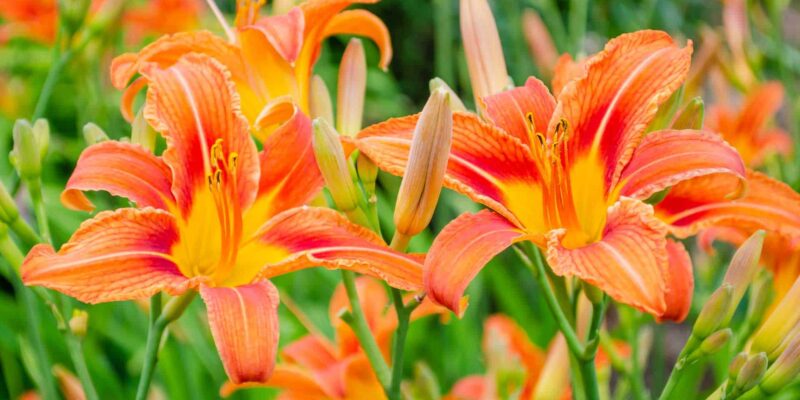
Daylilies offer an unparalleled spectrum of colours and forms, allowing gardeners to tailor selections to specific tastes or schemes. From pale yellows and soft pinks to deep reds and near-blacks, the palette exceeds 80,000 registered cultivars, as catalogued by the American Hemerocallis Society. Tetraploid varieties boast thicker petals and richer hues, while diploid types provide delicate, spider-like elegance. This diversity enables precise matching to garden palettes, whether coordinating with the blush of apple blossoms or contrasting against evergreen hedges.
In British contexts, where subtle tones often prevail in cottage-style plots, pastel daylilies like ‘Gentle Shepherd’ blend seamlessly with lavender or foxgloves. Bolder options, such as ‘Pardon Me’ with its wine-red trumpets, inject drama into formal layouts. Forms vary from classic rounds to recurved stars and double-flowered types resembling peonies, accommodating both modern minimalism and traditional exuberance. Gardeners can source these through specialist outlets, where daylily plants for sale often include detailed bloom charts to aid selection.
This variety extends to size and habit, with dwarfs reaching 30 centimetres ideal for rockeries and giants up to 1.2 metres suiting back-of-border positions. Foliage, evergreen in milder zones or deciduous in colder areas, provides year-round interest with its arching, grass-like strands. In fruit tree groves, compact forms underplant without overshadowing, while taller ones frame views. The Linnean Society notes that such morphological range stems from hybridisation efforts since the 19th century, yielding plants resilient to UK conditions.
Practically, this diversity mitigates monotony in larger spaces. A 20-plant collection might feature ten colours, ensuring no two summers repeat exactly. This adaptability fosters creativity, encouraging gardeners to experiment with themes—monochromatic yellows for sunny aspects or multicoloured mixes for wildlife corners. Ultimately, the sheer breadth of options positions daylilies as a versatile tool for personalising any garden, reflecting individual preferences within a framework of proven reliability.
Reason 4: Adaptability to Varied Soil and Climate Conditions
Daylilies demonstrate remarkable adaptability to a wide array of soil types and climatic variations, a trait that recommends them for diverse British landscapes. They tolerate pH levels from 5.5 to 7.5, thriving in sandy loams, heavy clays, or chalky substrates with basic amendments like gypsum for drainage. In areas prone to waterlogging, such as parts of East Anglia, raised beds or grit incorporation suffice to prevent root rot, while drought-prone southern counties benefit from their deep taproots that access subsoil moisture.
This flexibility suits the United Kingdom’s regional differences, from the mild, wet west to the drier east. USDA hardiness zones equivalent to 3 to 9 encompass most of the country, with plants surviving temperatures down to -30 degrees Celsius once established. In Scottish borders or Welsh valleys, they endure frost without protection, emerging unscathed in spring. Companion planting with fruit trees amplifies this, as daylilies stabilise soil around shallow-rooted apples, reducing compaction from foot traffic during harvests.
Soil preparation remains minimal: a 5-centimetre layer of organic matter at planting enhances establishment, but mature plants forage independently. The Soil Association reports that daylilies improve ground structure over time, their fibrous roots aerating compacted earth and preventing erosion on slopes. In urban gardens with contaminated sites, they absorb minor heavy metals, aiding remediation without specialised care.
For coastal plots exposed to salt spray, salt-tolerant cultivars like ‘Hyperion’ maintain vigour, unlike fussier perennials. This broad tolerance minimises site-specific adjustments, allowing gardeners to replicate successes across properties. In essence, daylilies’ adaptability ensures consistent performance regardless of locale, embodying a practical ethos for resilient, low-input gardening.
Reason 5: Support for Garden Biodiversity
Daylilies contribute significantly to garden biodiversity by attracting a range of pollinators and beneficial insects, fostering a balanced ecosystem. Their tubular flowers, rich in nectar and pollen, draw bees, butterflies, and hoverflies during peak blooming, extending foraging opportunities beyond native wildflowers. In fruit tree settings, this enhances cross-pollination, boosting yields of varieties like Discovery apples by up to 20 per cent, according to trials by the National Fruit Collection.
The plants’ clump-forming habit provides shelter for ground-dwelling invertebrates, such as beetles that prey on slugs, reducing chemical interventions. Foliage hosts ladybirds, which control aphid populations on nearby roses or vegetables. The Wildlife Trusts advocate daylilies for their role in urban green spaces, where they bridge gaps in nectar calendars, supporting declining species like the common blue butterfly.
Seed pods, if left intact, offer winter food for birds, while decaying leaves enrich soil with organic matter. This multifunctional support aligns with sustainable practices, minimising reliance on pesticides. In larger estates, swathes of daylilies create corridors for wildlife movement, linking hedgerows to ponds. Data from Buglife indicates that gardens with diverse perennials like these sustain 30 per cent more insect species than monocultures.
By integrating daylilies, gardeners cultivate not just beauty but vitality, promoting self-regulating habitats that require oversight rather than overhaul. This biodiversity boost underscores their value in contemporary, eco-conscious landscaping.
Reason 6: Simple Propagation Through Division
Propagation of daylilies via division offers an economical method to expand plantings without purchasing new stock. Every three to four years, established clumps can be lifted in autumn or early spring, separated into sections each with three to five shoots, and replanted immediately. This process yields dozens of new plants from a single mature specimen, with success rates exceeding 95 per cent under standard conditions.
In British gardens, where space often limits expansion, this technique allows scaling from a handful to a border-filling array within seasons. Divided sections establish swiftly, blooming the following year, unlike seeds that take two to three years. For fruit tree enthusiasts, divisions fill gaps left by pruning or replanting, maintaining coverage cost-effectively.
The Royal Horticultural Society recommends using a sharp spade for clean cuts, followed by thorough watering to settle roots. No rooting hormones are needed, simplifying the task for allotment holders. This self-sufficiency reduces expenses; a £10 plant can generate £50 worth of stock over a decade. Shared divisions through local clubs further build community ties.
This ease of multiplication democratises access to rare cultivars, enabling personalised collections. It also supports experimentation, such as trialling rebloomers in shaded orchard edges. Overall, division cements daylilies’ status as a resourceful perennial, amplifying garden potential through inherent generosity.
Reason 7: Robust Drought Tolerance and Longevity
Daylilies exhibit strong drought tolerance, surviving extended dry periods with minimal wilting thanks to their extensive root systems and waxy leaf coatings that conserve moisture. In southern England, where hosepipe bans occasionally occur, established plants endure weeks without irrigation, resuming growth upon rain. This hardiness extends their lifespan to 20 years or more in undisturbed sites, outlasting many perennials like asters.
Mulching with bark or compost suppresses evaporation, further enhancing resilience. In mixed plantings with fruit trees, daylilies draw from deeper layers, avoiding competition during summer stresses. The Environment Agency notes their utility in water-wise designs, aligning with conservation efforts.
Longevity manifests in increasing vigour; older clumps produce more scapes annually, creating denser displays. Pruning spent foliage in late winter tidies appearances without compromising health. This durability suits neglect-tolerant gardens, such as those of busy professionals.
In heritage orchards, daylilies persist through climatic shifts, providing stability amid changing weather patterns. Their endurance, coupled with aesthetic reliability, positions them as a cornerstone for enduring landscapes, rewarding patient gardeners with perpetual returns.
In summary, daylilies encapsulate the ideals of practical, rewarding gardening through their ease, endurance, and ecological contributions. Incorporating them yields a garden that thrives with foresight rather than force, adaptable to the nuances of British life. Whether enhancing fruit tree environs or standalone features, these perennials deliver enduring value.